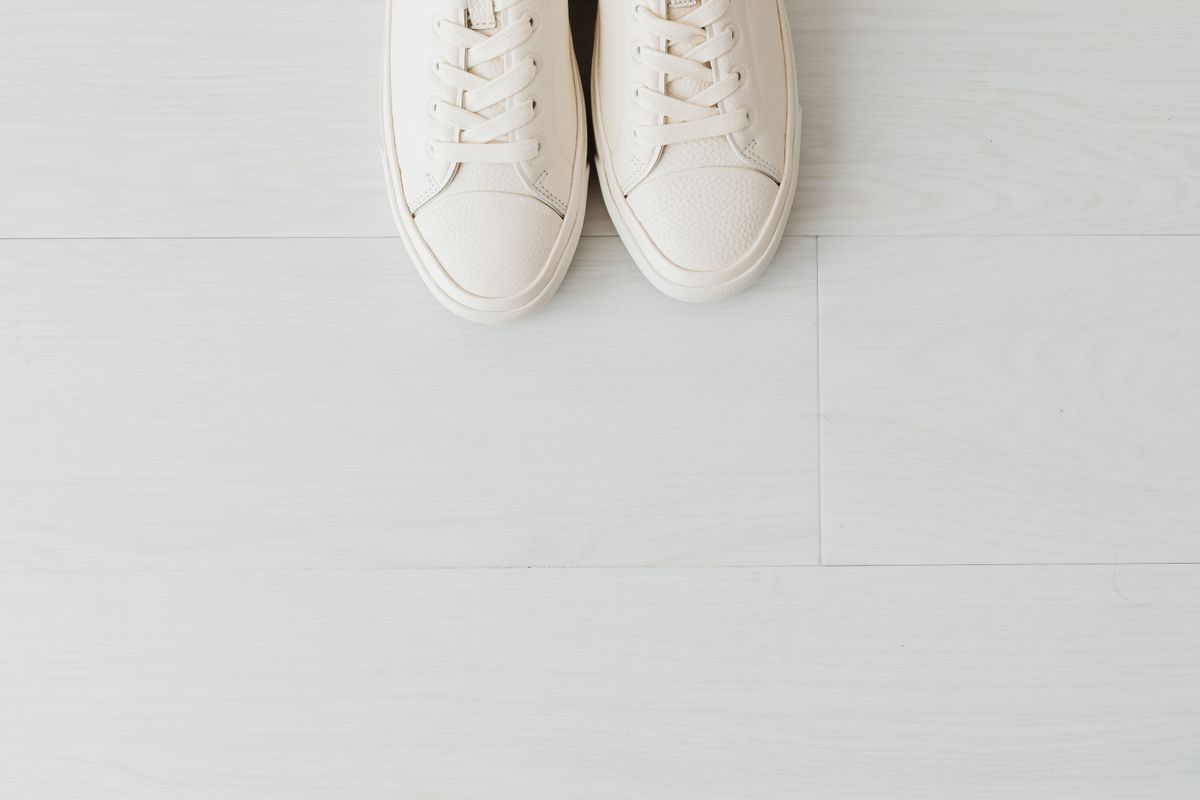
White leather sneakers are the most replaced shoe in a normal wardrobe —
often the footwear slot of a capsule wardrobe
— and the most uniformly marketed. Nearly every listing promises premium leather and
all-day comfort, and almost none of them tell you the two things that decide
how the shoe looks in month four: what the hide actually is, and how the sole
is attached.
This guide starts at the spec sheet, not the lookbook.
What the spec sheet can and cannot tell you
Three published details predict most of a white sneaker’s aging curve. First,
hide grade: full-grain leather keeps the outer layer of the hide, creases
but resists cracking; corrected-grain leather is sanded and sealed, looks
flawless on day one and tends to show coating cracks later. Second, sole
attachment: a stitched or vulcanized bond tolerates flexing and can often be
repaired; a pure cemented bond is lighter and cheaper, and it is where most
budget sneakers eventually separate. Third, lining: a leather or
cotton-blend lining absorbs foot moisture and dries; a full synthetic lining
traps it, which is why some white sneakers smell tired long before they look
tired.
What the spec sheet cannot tell you is fit. Owner feedback consistently
matters more there, particularly on width — several well-known minimalist
sneakers run narrow in ways their size charts never mention.
A quick map of the grade ladder makes those hide claims readable. Full-grain
is the hide’s outer layer, unsanded, with the densest fiber structure.
Top-grain comes from the same layer but is lightly sanded and usually sealed
with a finish, trading some breathability and patina for a uniform,
stain-resistant surface — one reason many clean-looking white sneakers are
top-grain even when the listing just says leather. Below that sit split and
bonded leathers — bonded is shredded leather fiber pressed with adhesive and
coated, the grade that peels rather than creases. The practical
tell is aging behavior — full-grain creases, coated grades crack. Neither is
a scam; corrected leather at a fair price is a legitimate value play. What
the grade predicts is month four: whether conditioner will absorb into the
leather or sit on its coating.
The three worth a closer look
Plenty of white sneakers are fine. Three are repeatedly worth their price,
for different reasons — one sets the minimalist benchmark, one is the value
play, and one splits the difference. Each is covered in the picks section
below with what its maker publishes and what owners commonly report.
Common Projects Original Achilles is the reference point for the whole
category — the sneaker most minimalist designs get compared to, priced
accordingly. Koio Capri occupies the tier just below it, with a similar
low-profile silhouette at a meaningfully lower price. Veja Esplar is the
value pick of the three, and the one most often recommended as a first
leather sneaker.
Caring for the parts that age first
Outsole material deserves a glance, because it takes the abrasion so nothing
else has to. A named rubber outsole can be wiped and wears down visibly long
before the shoe is done; once a sole wears smooth, street moisture starts
working at the bond above it.
Midsole yellowing deserves a sentence of chemistry, because it changes what
care means. The yellow is oxidation: ultraviolet light and oxygen react with
the rubber, EVA or polyurethane in a white midsole over time, forming
compounds that reflect yellow — which is why pairs yellow in the box as
readily as on the street. Heat speeds the reaction and moisture attacks the
polyurethane from the inside. The practical consequences: store pairs out of
direct sun, let them dry fully between wears, and skip sealed plastic, which
traps humidity against the shoe.
Creasing is normal for full-grain leather and mostly cosmetic. The failures
that actually end a white sneaker’s life are midsole yellowing, separation at
the cement line, and salt staining at the stitching. All three are slowed by
the same habit: wipe the shoe down after wear, let it dry away from heat, and
alternate pairs so the leather gets a full day to rest. A basic brush and a
pH-neutral cleaner cover ninety percent of upkeep; skip the bleach pens,
which are the most common cause of uneven yellowing reported in owner
feedback. A care kit full of bottles is rarely the answer a spec sheet points
to — the same lesson as reading a tote bag listing.