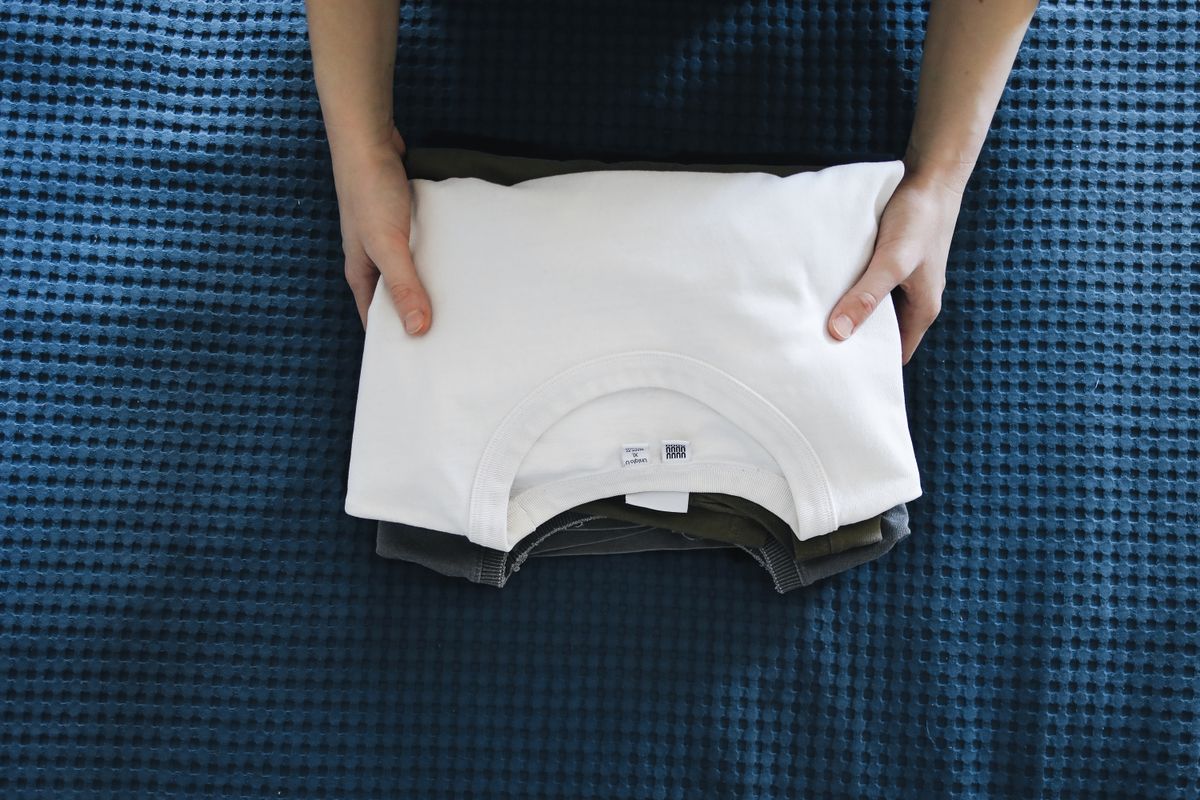
Capsule wardrobe content usually fails at the same point: it names thirty
beautiful things and lets you solve the budget yourself. This is the other
version. A working capsule is five slots, not thirty pieces — and each slot
has two or three construction details that decide whether the piece survives
its first year.
The five slots that carry a wardrobe
A white or off-white tee. The most replaced item in the list, so buy it
as a consumable: check the fabric weight (most everyday tees sit between
roughly 150 and 200 GSM; below about 150 the fabric goes sheer and loses
shape quickly), whether the hem is double-needle or coverstitched rather
than a single row that can pucker and twist in the wash, whether the collar
has ribbing with recovery — stretch it and see whether it snaps back — and
whether the maker publishes the cotton’s certification. Dark denim. The
decision that matters is raw versus pre-washed — raw sanforized denim shrugs
off months of wear before its first wash; pre-washed denim gives up its dark
finish gradually no matter how you treat it. Check whether the listing names
a fabric weight in ounces: mills that stand behind their denim usually do.
A mid-layer knit. Read the fiber percentage before the brand name: wool
blends under 30% merino or lambswool behave like acrylic with good
marketing, and pilling is where they announce it. Then look at construction —
shoulder seams that are linked rather than merely overlocked keep their shape
through more washes, and a published garment weight means the maker expects
comparison. A weather layer. Sealed seams matter more than waterproof
numbers for everyday rain; for occasional drizzle, a tightly woven untreated
cotton often reads better than a shiny membrane. Check that the piece is
washable at home, because a shell that demands dry cleaning stops being a
grab-and-go layer. Proper shoes. Covered in the white leather sneaker
spec check — the short
version is that sole attachment decides lifespan.
Why fabric weight is the first number on the tag
GSM is grams per square meter: how much fiber went into a given area of
cloth. It is the closest thing a basic garment has to a displacement
figure. Two plain tees can hang side by side and look identical, while the
190 GSM one holds opacity through a full year of washes and the 140 GSM
one goes sheer across the shoulders first, because there is simply less
fiber covering the same area. Weight drives durability in the same
direction — a heavier knit stretches out of shape more slowly and wears
through later. A maker who lists the number expects the fabric to be
judged; a listing that hides it usually has a reason.
Collar construction is the second read, and ribbing explains it. A ribbed
collar is knitted so the columns pull against each other, which is what
makes it spring back when you stretch it. Heat and tension relax that
memory wash by wash, and a collar with no recovery left rolls and waves
before the body of the tee shows any wear at all. Stretch the collar at
the rack: what snaps back today is a promise about month six. Hems tell
the same story in stitch form — a double-needle or coverstitched hem holds
the fabric’s tension against itself with two rows of stitches, which is
why it resists the pucker and twist that a single row develops.
Cotton claims sit one level above the numbers. Names like pima and Supima
refer to extra-long-staple cotton, a longer fiber that spins into a
smoother, stronger yarn than the short-staple commodity cotton in a basic
pack tee. A maker who pays for the named fiber usually wants you to know
it, so its absence on a listing is also a data point — the same
omission-reading that applies to denim weights and knit percentages below.
Denim: raw, pre-washed, and the ounce number
Denim weight gets its own unit: ounces per square yard. Everyday jeans
tend to land somewhere between ten and fourteen ounces, with heavier
denims above that, so a listing that names the weight is naming a fabric
you can compare across brands. Sanforization explains the raw-versus-washed
split. Sanforized denim has been mechanically pre-shrunk, which is why raw
sanforized jeans can go months before their first wash without the fit
turning into a gamble. Pre-washed denim has already been through the
tumble that pulls the dark finish down, and no home routine puts that
depth back.
The fade pattern comes from the dye itself. Indigo sits on the surface of
the yarn rather than soaking through it, so every crease that flexes the
yarn wears the color off at exactly the points where your body folds the
cloth. That is also why pre-washed denim loses its darkness gradually
rather than in patches — the finish was already disturbed before you
bought it. The first-year raw denim log
tracks what that difference looks like in practice.
The mid-layer knit: read the label twice
The fiber line comes first. Wool blends under 30% merino or lambswool
behave like acrylic with good marketing, and the mechanism is staple
length. Short fibers have ends that work loose under friction, clump
together, and felt into the little balls that ruin a sweater’s elbows and
sides. Long-staple wool anchors along the yarn and stays put, which is
why a high-percentage wool knit pills less even though wool is the softer
fiber. The 30% line on the label is not a softness threshold — it is a
staple-length threshold wearing a percentage sign.
Construction is the second read. Shoulder seams that are linked rather
than merely overlocked keep their shape through more washes: linking
joins the two panels stitch by stitch along their natural knitted width,
while overlocking cuts the edge and binds it, leaving a rigid seam
running through a stretchy cloth. A published garment weight means the
maker expects comparison, for the same reason the tee slot does. The
pilling routine once the sweater is home lives in the merino sweater
guide.
What the weather layer has to survive
Rain enters a shell through the needle holes before it enters through the
fabric. Every sewn seam is a row of perforations, which is why sealed
seams matter more than waterproof numbers for everyday rain: a taped seam
closes the perforations, and a high-rated fabric with open seams still
wets along every stitch line. For occasional drizzle, a tightly woven
untreated cotton often reads better than a shiny membrane, because the
weave itself sheds a passing shower and the cloth keeps its breathability.
Washability is the last check, and it is mechanical too. A shell that
demands dry cleaning stops being a grab-and-go layer, because the
cleaning bill and the errand both land between you and the door — and a
weather layer that lives on a hook is a purchase, not a tool. The
seam-sealing check covers
what taped construction should look like up close.
What “replaceable on purpose” means
Every slot above has a consumption profile. Tees die yearly and should be
cheap enough to rebuy without grief. Denim and knits should be bought once
and repaired. Weather layers sit in between. The audit question for each
piece you own is simple: when this wears out, do I know exactly what to buy
again? If the answer is no, you don’t own a staple — you own an impulse.
The audit needs a record to work against, and the record is cheap: what
the piece cost, when it entered rotation, and what failed first. A tee
that lasted four months at a low price is a different purchase than one
that lasted four months at three times the price, even though both are
dead. Without the dates, every dead tee feels like a betrayal and every
rebuy feels like a coin flip. With them, the capsule turns into a
shopping list — the slot, the spec, the expected interval — which is the
difference between a wardrobe and an inventory.
Why the boring pieces need the spec sheet more
The pieces with the least design interest carry the most wear. Nobody
re-reads the listing of a coat they love; the plain tee and the mid-layer
knit get worn weekly and washed dozens of times, so their failure modes —
collar slump, hem twist, pilling — are mechanical, not stylistic. That is
why the unglamorous slots are exactly where published specs earn their keep:
fabric weight, fiber percentage and seam construction are the only visible
differences between two plain garments. A ruffled collar can justify itself
on sight; a plain one has nothing to sell but its construction. The same
discipline behind reading a tote bag listing
applies — construction facts, not photography, predict the second year.
The replacement rhythm
A capsule fails at purchase as often as at design. Rebuild one slot at a
time: when a tee dies, replace it that week, to the same spec — same weight,
same collar construction — rather than waiting for a weekend overhaul. Buying
five replacements in one afternoon is how a capsule drifts back into impulse
shopping; the point of the audit is that every purchase arrives with its
spec already written and its reorder decision already made. Note what each
piece cost and how long it lasted, and the second cycle gets faster and
cheaper than the first, which is the entire return on the bookkeeping.
Three starting picks
If you are rebuilding from a near-empty closet, start with the tee slot. The
three we would hand a friend: Everlane The Organic Cotton Box-Cut Tee as
the daily default, Uniqlo Supima Cotton Crew Neck T-Shirt as the cheap
rebuy, and Merz b. Schwanen 1950’s Loopwheeled T-Shirt for the
long-game wardrobe — details and links in the picks section.