Clothing
Fused vs Half-Canvas vs Full-Canvas: Reading a Blazer Shoulder
How fused, half-canvas, and full-canvas blazer construction differ, what roped and soft shoulders tell you, and how to check a jacket before buying.
By Claire Donovan · Published Sep 8, 2026 · Updated Sep 8, 2026
The short version
How fused, half-canvas, and full-canvas blazer construction differ, what roped and soft shoulders tell you, and how to check a jacket before buying.
Every label term in this guide is explained in what the symbols actually mean .
Blazer marketing barely mentions construction anymore, yet construction is the difference between a jacket that molds to you over five years and one that bubbles apart after two. Three building methods dominate: fused, half-canvas, and full-canvas. The price ladder tracks them so reliably that construction is the first thing worth checking on any blazer over about two hundred dollars.
The three constructions, and where the price breaks
Fused construction glues a fiber interlining to the shell fabric with adhesive. It is fast, cheap, and light, and it dominates the market below roughly the mid-hundreds. Half-canvas adds a floating canvas — traditionally wool and horsehair — stitched through the chest and lapel area only, with fusing below; it is the value sweet spot because it puts the molding, shape-holding structure where it matters most at a fraction of full-canvas labor. Full canvas floats a complete inner structure stitched to the shell throughout, letting the whole jacket drape and adapt; it is the tailoring standard and usually priced accordingly, from the high hundreds upward. These are market patterns, not laws — but a full-canvas claim at a fast-fashion price deserves skepticism, and a fused jacket at a tailoring price deserves a walk away.
What the floating canvas actually does
The canvas at the center of a half- or full-canvas jacket is a coarsely woven layer, traditionally wool and horsehair, and the horsehair is the ingredient that matters. It is springy: the canvas holds a pressed shape instead of lying flat, so when a tailor irons the chest and lapel over a curved form, the front takes on a gentle swell and the lapel acquires a roll rather than a fold. Because the layer floats — stitched at intervals, glued nowhere — the shell can still move and stretch, and the whole front responds to years of wear by settling into the wearer’s posture. That is what “it molds to you” literally describes. Fusing imitates the shape with adhesive and produces a lapel that looks right on the hanger but has no memory; once heat or cleaning breaks the bond, the shape was never in the fabric to begin with.
Shoulders: the shape vocabulary
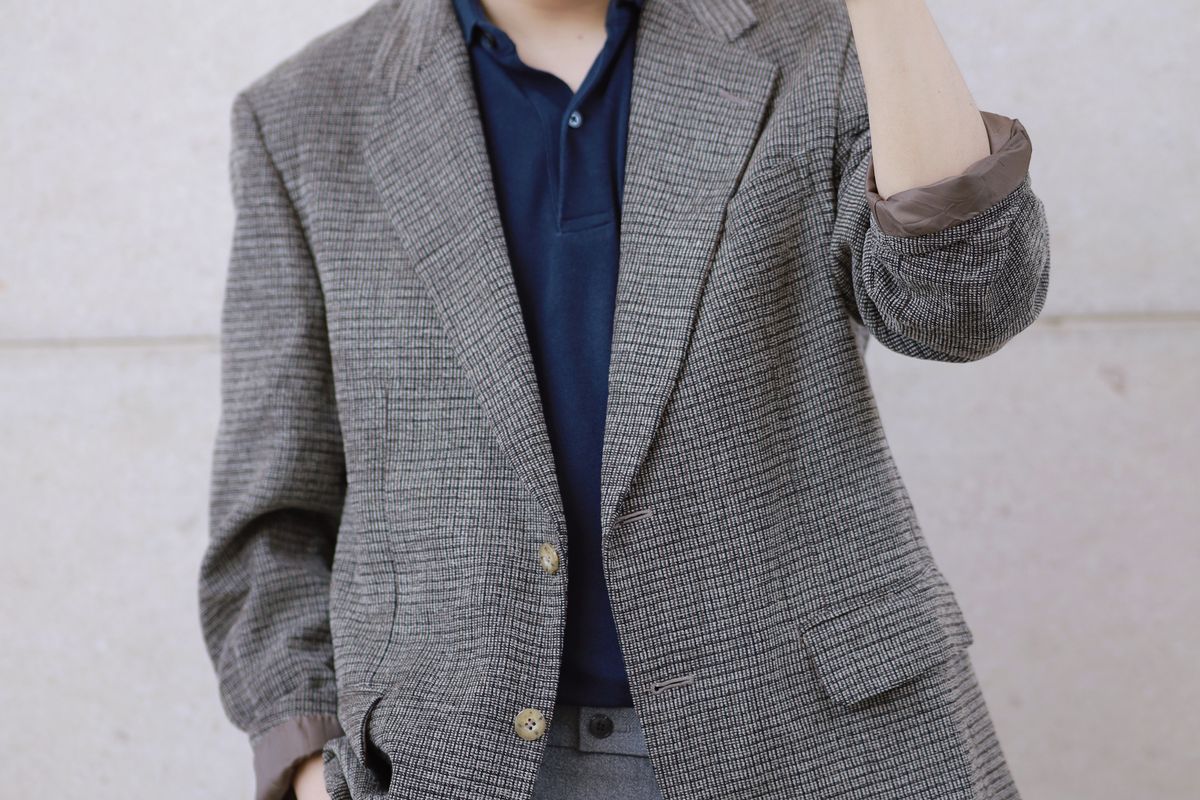
Two terms carry most of the meaning. A roped shoulder has a gathered, slightly puckered sleeve head that extends the shoulder line outward — Neapolitan tailoring’s signature, structured and formal. A soft shoulder, common in Italian and modern American cuts, is unpadded and unpinned, following the wearer’s natural line. Neither is better; they are dialects. What matters when shopping is consistency: a jacket claiming soft, casual tailoring should not arrive with dense shoulder pads, and a structured business jacket with a completely flat shoulder will read cheaper than its price. The shoulder is also where canvas structure shows most — a lapel that rolls in a smooth curve rather than folding on a flat crease usually has canvas under it.
The lapel roll, read slowly
The lapel is the most honest few inches of any jacket. Canvas construction gives the lapel a gradual curve, so light travels along a rounded ridge and the roll fades softly into the chest. Fusing produces a hard crease: a flat fold with a visible edge, the same geometry as a folded sheet of paper. Watch how the lapel behaves when the jacket moves, too — a canvas lapel swings and settles, while a stiff one holds whatever angle it was pressed into. This single check takes five seconds, needs no tools, and predicts the construction more reliably than any label claim.
The in-store check, outside and in
Outside: pinch the chest fabric between thumb and forefinger. Fused feels like two stiff sheets glued together; canvas feels like three layers with a pliable one floating between. Then cup the lapel and roll it — canvas lapels curve, fused lapels crease. Inside: look through the armhole or hem opening for the edge of a floating canvas layer, and inspect the lining stitching density while you are in there. Thirty seconds covers it, the same label-and-seams discipline we use in the capsule wardrobe audit and reading a tote bag listing.
What delamination actually looks like
When fused interlining fails, the adhesive bond breaks and the shell separates from the backing in patches: visible bubbles at the chest, lapels that ripple instead of lying flat, a crinkling sound when pressed. Heat from dry cleaning presses and years of body warmth accelerate it, and it is not repairable — the fusing cannot be re-bonded cleanly. This is the entire argument for canvas at higher price points: stitched structure has no adhesive to fail, so its worst case is a worn jacket, not a blistered one.
Keeping the shape after purchase
Construction sets a ceiling; habits decide how much of it you keep. A canvas jacket recovers from a day’s wear overnight, which is why tailors recommend rest days and a broad wooden hanger that fills the shoulders rather than a thin wire one that creases them. Steam refreshes a canvas front gently and renews the roll of a tired lapel; a hot dry iron does the opposite, pressing the shape flat. Dry cleaning less often than the fabric seems to ask for extends any jacket, and it extends a fused one the most, because every cleaning press is another round of heat the adhesive absorbs. None of this rescues a badly made garment, but a good jacket under decent care reads as the bargain it was.
Alterations are where fused jackets get expensive
Construction also decides what a tailor can do later. A canvas jacket can be taken apart at the seams, re-pressed over a form, and rebuilt, because the structure tolerates heat and handling. In a fused jacket the adhesive is the structure, and pressing it risks reactivating the glue; the alteration window is narrower, and taking in a fused chest can leave new bubbles behind. Letting a jacket out depends on seam allowance, not construction, but reshaping a chest is where the two methods separate. Pay for canvas if you expect your body or your fit preferences to change over the life of the jacket; pay for fused construction if the fit is already right and the horizon is a few years.
Claire Donovan
Spent eight years in womenswear buying before moving to editorial research. Reads care labels for fun and returns nothing without a wear log. How we rate.
More in Clothing
FAQ
- Is a fused blazer always a bad purchase?
- No. Fused construction keeps cost and weight down and is perfectly serviceable at lower prices, as long as the fusing is well bonded. The problems appear over years: heat and dry cleaning can break the adhesive bond, and that is when bubbling and delamination start. Buy fused knowing it is a shorter-lifespan garment.
- How can I tell if a blazer is fused without asking?
- Pinch the layers of the chest area between your fingers from the outside — a fused jacket feels like two flat sheets of paper, while a canvas jacket feels like a third, pliable layer floating between fabric and lining. Also check that the lapel rolls gradually rather than folding on a hard crease, and look inside the sleeve or hem opening for the canvas edge if you can.
- Does full canvas really last that much longer?
- Yes, mechanically: the canvas is stitched to the shell rather than glued, so there is no adhesive to fail, and the jacket molds to the wearer over years of wear. That is why tailoring houses treat full canvas as the default for garments meant to be altered and kept for decades. The trade-off is price, weight, and a longer break-in period.